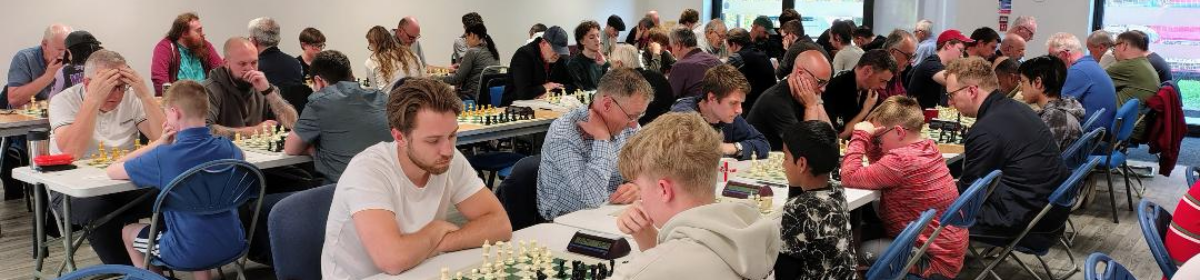
Important notes from today’s session:
Training should focus on doing the fundamental, important skills consistently and well, so they can be used effectively in real games. Visualising and calculating tactics is probably the single most important skill that decides the results of games. This is the skill that we try to develop in Task 1 (see below). The most important use of calculating is to avoid giving tactics to your opponent. This applies to all our games, from intermediates outplaying opponents rated 300 points higher, to quadruple-time, three-years-running Division 1 Club Champions!!
There are several reasons why managing tactics in a game is much harder than solving tactics in puzzles:
In a game, you can’t be sure that there is a tactic to be found. Even if there is what Heisman calls a Seed of Tactical Destruction, it doesn’t necessarily mean there is a definitely a tactic.
In a game, there are lots of important thoughts that distract your attention: “What’s my plan here? What’s he trying to do- attack my King? Am I winning or losing? Should I enter an endgame here?”
In a game, the clock is ticking, so you have to judge whether to invest time now to try to find the tactic (that may not exist), or save time for later.
In a game, your opponent has tactics and traps that you could fall into, so you have to look out for these too.
Bridging the gap between puzzles and games is what we will try to do with Task 2 (see below).
Training tasks that you can do at home (choose one of these):
Task 1: Practise Tactical puzzles (especially if you don’t already have a habit of doing tactical puzzles):
Go to the lichess website, click on the Puzzles tab, and do 10-20 puzzles in a row. (You don’t need to sign up to do this, but if you have an account you can see your progress.)
If you want to practise doing specific tactical themes, such as forks or deflection, lichess allows you to do that.
Start each puzzle by assessing the material balance and looking for exposed Kings or other pieces.
Look for arrangements of pieces that might suggest a tactic to win material or checkmate. These “Seeds of Tactical Destruction” help you identify the targets of your tactics.
List your available checks, captures or threats (forcing moves that you can calculate). Don’t dismiss a possible move for superficial reasons (“I can’t go there; he’ll just take it”). Look beyond the obvious!
Calculate the variations, starting with the forcing moves- do this out loud to help you visualise the moves. Be specific: instead of saying, “There, there, check, takes, takes…,” it is more disciplined to call out the moves: “Rook c1 check, King h2 (he can’t block because I take on d1 and my Queen protects my Rook), Rook h1 check, he takes on h1, Queen takes h3 check and he can’t take because his pawn is pinned to his King on h1. He can only move his King to g1 or block with his Bishop, but in either case Queen takes g2 is checkmate. Right, I’m confident I’ve seen everything.”
Be thorough!! Make sure you’ve visualised ALL possible defences (and how to defeat every single one) BEFORE making your first move. The important skill that’s being practised here is visualisation: seeing difficult moves and putting them together in a winning sequence.
Never rush, and never guess! (Unless you’ve been thinking for over 10 minutes and still can’t see a way forward.) You’re aiming for thoroughness, not speed.
There’s only ever one correct move that wins, so if you think there are two winning moves, you need to look deeper because one of them is faulty.
Do this once per week- you can do it more often if you choose, but set yourself an easy goal to start with. Don’t worry if the tactics are “too easy”- the aim is to practise visualisation, so you can do it better during a game. (If you’re really keen for harder puzzles, setting up an account lets the website adjust puzzles to match your level.)
Task 2: Play a Serious Game
Once per week, commit to doing your best in a timed game where you have at least 20 or 30 minutes for the whole game. It could be online against a stranger from another country, or in person on a Tuesday evening at the Club, or even a League game (where it really counts!!).
Make a big effort to ask yourself, before every move: “If I play this move, am I giving him a tactic?” (The exception is if you’re playing an opening from memory, or if you only have one legal move in the current position).
Doing this consistently starts to bridge the gap between being able to do tactics in a puzzle, and controlling those same tactics in a real game.
[ Interestingly, you should note that, when I invited Martin to tackle a difficult position, he made a very profound comment: “In a game, I’d be really tempted to take on c3, but I’m trying to see why it’s a blunder.” This is the self-flagellating version of “Am I giving him a tactic?” Martin, one of the strongest players at the club, automatically did something that stronger players always include in their thinking: they try to falsify their ideas. Before deciding that a move is good, they first try to find what is wrong with it. (If you have a background in Science or Maths, you’ll recognise that this is how hypothesis-testing works.) Strong players use their calculation skills to see if there’s something wrong with their move, and only when they fail to refute their move do they conclude the move is Safe. (Even though the move is Safe, that doesn’t mean it is the Best Move: that’s a discussion for another day!)
By contrast, very inexperienced players (who are blissfully unaware of the opponent’s tactical resources) habitually bash out the first aggressive move they find, confident that it’s a good move but not taking care to check it at all. The result is they end up both very confident AND wrong at the same time(!!). ]
After the game, especially if you lost, review the game with a chess-buddy (perhaps your opponent, or a strong player at the club):
Find the 1 or 2 (or 3?!) moments when the position went from level to losing for you. (A strong player can help here, or a chess engine can show when the evaluation went from between 1.0 and -1.0 to more than 2.0 for either player.)
For these pivotal moments, answer these questions:
“Why did I play that move? What was wrong with it?”
“Why did I allow the tactic?” (Maybe you were tired, low on time or distracted by a loud noise nearby; or you weren’t paying attention to your own Seeds of Tactical Destruction and failed to spot he could fork your Rooks)
“What move could I have played, and why is that better?”
“So what lesson can I learn for future?”
Have fun with these Self-Training Tasks, see if they make you approach your games in a different way, and I’ll see you next time!
Richard