Hi Everyone- thank you for joining me for the second online session on Sunday 8th November. Hope it was enjoyable- here are some notes of the important points from that session. Looking forward to hosting another session in December!
Notes from our second online session:
Calculation is the ability to visualise sequences of moves for both sides, to anticipate possible future positions. Accurate calculation (and correctly judging which of those future positions is most favourable) is the single most important determinant of chess-strength.
So keep practising tactics puzzles! Pay attention to Seeds of Tactical Destruction, as they help identify those forcing moves (check, captures, threats- in that order) that are likely to lead to winning tactics. This works both ways: in your games, remember to ask- before any move that you make- “If I do this move, will I give him a tactic? What Seeds of Tactical Destruction are in my position, and which of his forcing moves might exploit them?” This issue is not to do with difficulty, but with discipline.
The tactics that decide games are usually not especially difficult. They’re normally quite easy to see: for example if you show a player the position where he lost by allowing a tactic, and ask him to find it, he spots it immediately. But they’re impossible to anticipate in a real game if you’re not looking for them in the first place. In order to train this, have a look at my notes from the first online session and have a go at Tasks 1 and 2: the first aims to improve tactical vision, while the second helps you bring that skill into your games
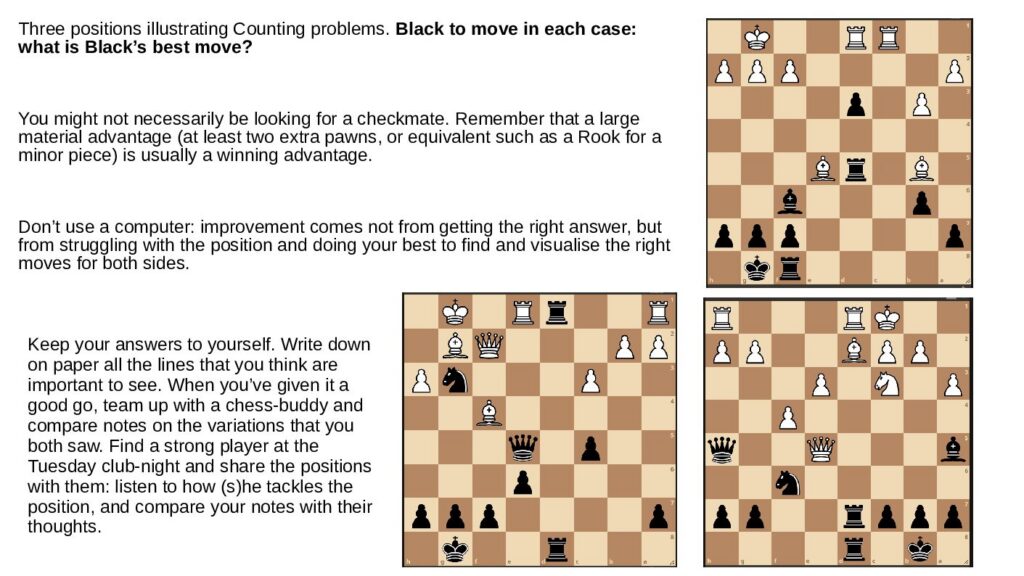
Heisman mentions that two of the commonest calculation errors made by improvers are: Hanging Piece and Counting Error. Hanging Piece means putting a piece on a square where it is unprotected and can just be captured. Counting Error means that a piece or pawn is protected, but the number of attackers is greater than the number of defenders: this usually results in the defender losing material. Positions involving Counting problems on multiple squares can become very complicated, requiring accurate calculation from both sides to determine the best continuation.
If you would like a challenge, have a look at the attached slide, with three positions involving Counting problems.
Another common error in calculation is something that Heisman calls a Quiescence Error: you calculate a variation and think it leads to a decent position. But when that position arises on the board, you realise- too late- that there is a (simple) tactic available to your opponent, and this costs you the game. The mistake was assuming the position was Quiescent, when in fact there were further forcing moves to calculate. The remedy for this is to always look one move further in the variation than you think necessary: what Seeds of Tactical Destruction still exist in the position, and what moves might exploit them?
Best wishes, Richard